


Harvest, installation detail, 2025 at LaVallée
To mark the 10th anniversary of LaVallée, the Creative Hub has invited the Italian artists Alessio Bogani (b. 1977) and Stefano Moras (b. 1985) to develop a special exhibition as part of the 10th Anniversary Festival.
Expanding on their original concept, the artists have reimagined the project as a collaborative artistic residency.
For the occasion, they have brought together a group of international artists to explore urgent contemporary issues such as sustainability, anti-speciesism, and the Anthropocene. The title of the project is inspired by the concept of “interbeing,” a term coined by Vietnamese Thiền Buddhist monk and peace activist Thich Nhat Hanh.
The residency brings together artists from a range of disciplines and cultural backgrounds promoting interdisciplinary research, production, and public engagement.
Participating artists
Alessio Bogani
Stefano Moras.
Edmondo Riccardo Annoni
Nina Ćeranić
Manuela Kokanović
Giovanni Munari
Sebastiano Pallavisini
Guests talk
Sergio Barbarino
Alessandra Marcon


Interbeings
Cohabitation between osmosis and resistance
The intensity of interspecific relationships, intertwined with natural processes, has generated a welcoming and diverse living environment: the biosphere. It holds together a considerable variety of living species, on which we depend for our survival. This goes far beyond the idea of a supposed separation between humans and the rest of the living world, known as Nature. The way we live and conceive the space we inhabit often contributes to reinforcing the illusion of our independence from it, fuelling an idea of human supremacy that is nevertheless clearly showing its limits.
The dominant urban narrative, reinforced by Western policies and United Nations projections, pushes the human population to concentrate in metropolitan areas that are poor in biodiversity, while industrial agriculture is depopulating and degrading rural landscapes, thereby exacerbating the climate and biodiversity crises and deepening the divide between town and country.
In the face of this global trend, alternative movements are emerging, such as agroecology, which promote a “back-to-the-land” and a reconnection with natural common goods (soil, air, water) and with all the forms of life that make our existence possible. Agroecology highlights the centrality of interspecific relationships and revalorises peasant knowledge and ways of life.
But how far does cohabitation between species go?
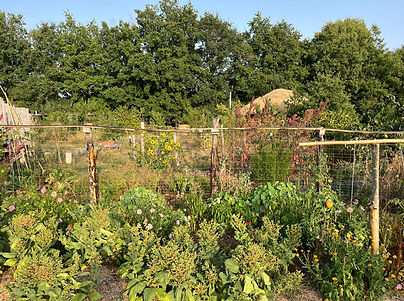
The talk is inspired by a recent stay at the agroecological space Champ des écoutes, located in the Bocage of the Vendée. Starting from an encounter with a specific species of arthropod, Apis mellifera, it serves as a pretext for reflecting on the cohabitation between human and non-human species, questioning the principles of osmosis and resistance. This will raise questions that are not necessarily new, but which are useful for rethinking the future conditions of the habitability of the biosphere.
Abstract from the Lecture by Alessandra Marcon
Thanks to
.png)